Last updated: 14th May 2026
Reviewed by: Ben Dinmore, Direct Debit specialist at London & Zurich
Everything you need to know about setting up, managing and getting more from Direct Debit.
What you’ll learn in this guide:
- What Direct Debit is and how it works
- The benefits of Direct Debit for your business
- How to set up Direct Debit step by step
- What a Service User Number (SUN) is and whether you need one
- How Direct Debit costs and fees work
- How to stay compliant with Bacs and otherFCA requirements
- How to choose the right Direct Debit provider
- How to switch providers without disrupting your collections
Direct Debit facts:
|
What is Direct Debit?
Direct Debit is a UK payment method that allows businesses to collect money directly from a customer’s bank account on an agreed date. The customer authorises the payment in advance via a mandate, and the business can then collect fixed or variable amounts on a regular or one-off basis.
Direct Debit is one of the UK’s oldest and most trusted payment methods. Unlike card payments, which can fail when a card expires or a limit is reached, Direct Debit goes straight to the source: the customer’s bank account. That makes it more reliable and predictable.
A Direct Debit is not a standing order, a bank transfer or a card payment. It’s its own thing, with its own rules, protections and advantages for businesses that use it properly.
Read more: What is Direct Debit?
How does Direct Debit work?
- Mandate. Your customer completes a Direct Debit mandate – essentially a signed authorisation giving you permission to collect payments from their account. This can be done on paper, online or over the phone.
- Submission. You (or your bureau provider, if you’re using a managed service) submit the instruction to Bacs, the UK payment scheme that processes all Direct Debits.
- Processing. Bacs processes the submission over a three-day cycle. This is the standard timeline for all Direct Debit payments in the UK.
- Collection. The funds leave your customer’s account and arrive in yours. If the payment fails for any reason (insufficient funds, a closed account, a cancellation) you’ll be notified and can take action.
- Reconciliation. Your platform records the outcome of every collection, giving you full visibility of what was paid, what failed and what’s outstanding.
What is a Direct Debit mandate?
A mandate (sometimes called a Direct Debit Instruction (DDI) is the formal authorisation your customer gives you to collect payments from their account. Without a valid mandate, you can’t collect. With one, you have ongoing permission to collect payments according to the terms your customer has agreed to.
Mandates can be set up in three ways: on paper, online via a web form or over the phone using a process called AUDDIS (Automated Direct Debit Instruction Service). Online and phone mandates are now the most common as they’re faster, easier and immediately validated.
Customers can cancel a mandate at any time by contacting either you or their bank. That’s part of the Direct Debit Guarantee, which we cover in the compliance section. But the important point for businesses is this: an active mandate stays valid until it’s cancelled.
Read more: Learn about Direct Debit mandates.
What is Bacs?
Bacs Payment Schemes Limited is the organisation that runs the Direct Debit scheme in the UK. It sets the rules, processes the transactions and is ultimately responsible for the integrity of the system. Every Direct Debit payment in the UK goes through Bacs.
Bacs also runs the Faster Payments scheme and manages CHAPS, but Direct Debit is where it has the longest history. The scheme has been running since 1968 and processes billions of payments every year.
Read more: What are Bacs and CHAPS payments?
Direct Debit vs standing order
A standing order is a fixed, recurring payment set up and controlled by the customer. They decide the amount, date and frequency. If the amount changes, they have to change it. If they want to cancel it, they cancel it. The business has no control.
A Direct Debit is controlled by the business. You set the amount (which can vary), the date and collect when you need to. The customer authorises it upfront, but you’re the one driving the collection.
Read more: The difference between Direct Debit, standing order and card payments
Direct Debit vs card payments
Card payments are great for one-off transactions at the point of sale. Direct Debit is built for recurring revenue.Think subscriptions, memberships, regular invoices or anything where you’re collecting on an ongoing basis.
The key practical difference is reliability. Cards expire. Limits get hit. Details change. Every one of those events is a potential failed payment. Direct Debit goes straight to the bank account, which means fewer points of failure and a consistently higher collection rate.
Card payments are better for the initial transaction, which is why many businesses now use card for the first payment and Direct Debit for everything after.
Read more: Direct Debit or card payments
Key takeaways
- Direct Debit is controlled by the business, not the customer
- It works via a three-day Bacs processing cycle
- A mandate is a customer’s formal permission to collect and is required before any collection
- It’s more reliable than card payments for recurring collections
- It’s fundamentally different from a standing order or bank transfer
Why do businesses use Direct Debit? The benefits
|
Businesses use Direct Debit because it provides predictable, automated cash flow with lower failure rates than card payments. It reduces admin, improves customer retention and is one of the most cost-effective ways to collect recurring payments in the UK.
The benefits:
- Less time chasing
- Better visibility of what’s coming in
- Higher collection rates
- Fewer awkward conversations with customers about missed payments
- More confidence in forecasting
For businesses whose model depends on reliable, repeat collections, this predictability can be transformative.
| Handling high volumes of transactions, reducing errors & improving customer experience
“London and Zurich have been a breath of fresh air to Bradfield college sports complex. They have really helped us improve our business and the way we collect money from our members” – Bradfield College Sports Complex |
Read more: The benefits of Direct Debit
How do you set up Direct Debit for your business?
To set up Direct Debit as a business, you need either your own Service User Number (SUN) from a bank or a managed bureau service through a provider. Most small businesses use a bureau service, which handles all technical and compliance requirements on your behalf.
The setup process is simpler than most people expect, especially with a managed bureau service. You don’t need to be a payment expert or build your own systems.
Here’s how it works, step by step.
- Choose your own SUN or bureau service. The first decision is whether you want your own Service User Number (SUN) from your bank, or whether you’d rather use a bureau provider who already has one. For most SMEs, the bureau route is faster, cheaper and significantly less complicated. We cover both options below.
- Select a provider. Take your time with this one. Look at support levels, pricing, compliance expertise and integration options. What help is on offer if something goes wrong?
- Complete onboarding and compliance checks. All reputable Direct Debit providers are required to carry out compliance checks before you can start collecting. This is a regulatory requirement. A good provider will guide you through this without making it feel like a headache.
- Set up your mandate collection process. Decide how your customers will authorise their Direct Debits – online form, paper mandate or phone. Most businesses use online mandates. Your provider will give you the tools to set this up.
- Configure your payment schedules. Set up your collection dates, amounts and frequencies in your portal. You can automate collections entirely, with full visibility of every payment.
- Start collecting. Once everything is set up and your first mandates are in, you’re ready to go. Your first collections will follow the standard Bacs three-day processing timeline.
What is a Service User Number (SUN)?A Service User Number (usually called a SUN) is a unique six-digit number assigned to businesses that collect Direct Debits. It’s essentially your identifier within the Bacs scheme. Every collection shows the originator’s SUN on the payer’s bank statement. To get your own SUN, you apply directly to your bank. The process involves compliance checks, a review of your business and approval from Bacs. For established businesses with a strong banking relationship, this is achievable. For smaller or newer businesses, banks often decline, which is where a bureau service comes in. With a bureau service like London & Zurich, you don’t need your own SUN. We use ours on your behalf, handling all the Bacs compliance and processing, so you get all the benefits of Direct Debit without the administrative burden of managing your own scheme membership. |
What is a Direct Debit bureau service?A bureau service is a fully managed approach to Direct Debit. Instead of managing the Bacs relationship yourself, you work through a specialist provider who handles the submission, processing and compliance on your behalf. With a bureau service, you get:
For most SMEs, this is the right route. It’s faster to set up, less resource-intensive to manage and gives you access to expertise you’d otherwise have to build yourself. |
How long does it take to set up Direct Debit?
With a managed bureau service, most businesses are collecting within one to two weeks of their first conversation with us. The biggest variable is how quickly compliance checks can be completed which depends on the complexity of your business and how promptly you can provide the required documentation.
Setting up your own SUN through a bank takes considerably longer – typically four to six weeks, sometimes more.
What do you need to set up Direct Debit?
- A registered UK business
- A UK business bank account
- Basic company information for compliance checks
- A clear description of what you’ll be collecting for
- A way to collect mandates from your customers (online form, paper or phone)
Read more: How to get started with Direct Debit
Key takeaways
- Most SMEs use a bureau service as it’s faster and requires no SUN of your own
- With a bureau provider, setup typically takes one to two weeks
- Compliance checks are a regulatory requirement – a good provider makes them straightforward
- You need a UK registered business and bank account to get started
Ready to get started? Talk to our team today.
How much does Direct Debit cost for businesses?
At London & Zurich, we charge a flat rate fee with no hidden charges.
Unlike card processing, where fees are typically a percentage of the transaction value, Direct Debit fees are usually flat (a fixed amount per collection) regardless of how much you’re collecting.
For a business collecting £50 a month from 500 members, the difference between a 2% card fee and a 5p Direct Debit fee is significant.
Most bureau providers charge in two parts:
- A monthly platform fee: covers access to the portal, support, compliance management and your account management
- A per-transaction fee: charged for each collection processed, typically in the range of a few pence
Some providers also charge setup fees, failed payment fees or minimum volume fees. These vary by provider and are worth asking about directly before you sign up.
Is Direct Debit cheaper than taking card payments?
For recurring collections, Direct Debit is almost always more cost-effective. Card processing typically costs 1.5–3% per transaction, plus monthly fees. Direct Debit fees are usually a fraction of a penny-per-pound collected, making it significantly cheaper at any meaningful volume.
What fees should I watch out for?
Not all Direct Debit pricing is as transparent as it should be. Here are the charges worth asking about before you commit:
- Failed payment fees: some providers charge for every failed collection
- Cancellation fees: check your contract terms if you’re switching from another provider
- Minimum volume commitments: some providers require a minimum number of collections per month
- Price increase clauses: check how and when pricing can change
At London & Zurich, we publish transparent pricing with no hidden fees. If you want to see exactly what your collections would cost, our pricing calculator gives you an instant estimate.
What are the rules and regulations for Direct Debit in the UK?
Direct Debit in the UK is governed by Bacs and regulated by the Financial Conduct Authority (FCA). Businesses collecting Direct Debits must comply with the Direct Debit Scheme Rules, give adequate advance notice to customers before collecting and handle customer data in line with GDPR.
Compliance is one of those areas where the detail genuinely matters, and where having expert support alongside you makes a real difference. The good news is that the core rules are straightforward once you understand them. The less good news is that they change, and keeping up with every update is time-consuming if you’re trying to do it yourself.
This section covers the essentials. If you want the full picture, our compliance team is always happy to talk it through.
The Direct Debit Scheme rules
The Direct Debit Scheme Rules are the rulebook for everyone using Direct Debit in the UK. They cover everything from how mandates must be obtained to how failures are handled and how indemnity claims work. They’re maintained by Bacs and updated periodically, which is one of the reasons having a specialist bureau provider helps.
As a business collecting Direct Debits, you’re responsible for understanding and adhering to these rules. If you’re using a bureau service, your provider will take on much of that compliance burden on your behalf.
Read more: Direct Debit rules
Advance notice requirements
Before collecting a Direct Debit, you must give your customer advance notice – telling them the amount, collection date and the frequency. The minimum notice period is 3 business days, but the recommended standard is 10 working days.
For new mandates, this notice is usually given as part of the sign-up confirmation. For changes to existing collections (amount or date changes) you must give sufficient advance notice before the change takes effect.
GDPR and data protection
Collecting Direct Debits means handling personal financial data – bank account details, sort codes, customer names. That puts you squarely within the scope of GDPR and the UK Data Protection Act.
Your obligations include: collecting data only for legitimate purposes, storing it securely, not retaining it longer than necessary and giving customers the right to access and delete their data. A reputable Direct Debit provider will have appropriate data handling processes in place and will support you in meeting your own obligations.
What is the Direct Debit Guarantee?
The Direct Debit Guarantee is a consumer protection scheme that applies to every Direct Debit collected in the UK. It gives customers the right to an immediate refund from their bank if a payment is taken in error. It also requires businesses to give adequate advance notice before collecting.
For businesses, the Guarantee is one of the reasons customers trust Direct Debit, and one of the reasons it has such high adoption. The flip side is indemnity claims, which we cover below.
What are Direct Debit indemnity claims?
An indemnity claim happens when a customer disputes a Direct Debit collection and their bank refunds them. The funds are then claimed back from you, the originator.
Indemnity claims can arise from genuine disputes, from customers who have forgotten they set up a Direct Debit or from fraud. They’re a normal part of running a Direct Debit scheme, but keeping them low matters both for your cash flow and for your standing within the scheme.
| Across our business, the Direct Debit indemnity claim rate is less than 0.05% |
A good bureau provider will help you manage indemnity claims properly, responding within the required timeframes, disputing where appropriate and tracking patterns that might indicate an underlying issue.
What is AUDDIS?
AUDDIS stands for Automated Direct Debit Instruction Service. It’s the electronic process by which new Direct Debit mandates are submitted to the Bacs system – replacing the old paper-based process. Almost all new mandates are now processed through AUDDIS, which means faster validation, faster setup and fewer errors.
How do Direct Debit rules change and how do I stay compliant?
Bacs updates the Direct Debit Scheme Rules periodically. New SME regulations are also on the horizon for 2027. Staying on top of every change is time-consuming if you’re doing it alone.
We track every regulatory change, update our processes accordingly and communicate anything that affects our clients. You don’t need to become a compliance expert – you just need a provider who already is one.
Key takeaways
- Direct Debit is governed by Bacs Scheme Rules and regulated by the FCA
- You must give customers advance notice before any collection
- GDPR applies to the handling of customer bank details
- The Direct Debit Guarantee protects customers and builds their trust in you
- A managed bureau provider handles most compliance obligations on your behalf
How secure is Direct Debit?
Direct Debit is one of the most secure payment methods available to UK businesses. Transactions are processed through the Bacs scheme, which is regulated and audited. Businesses and customers are protected by the Direct Debit Guarantee. Reputable providers add further layers including encryption, MFA and 24/7 monitoring.
Security is something we take more seriously at London & Zurich than almost anything else. Not just because our clients expect it, but because we know it matters. We’ve seen first-hand what happens when security fails, and our response is to continually build on our monitoring and protection capabilities.
Here’s what you need to know about Direct Debit security and what to look for in a provider.
How the Bacs system protects payments
The Bacs scheme has built-in security at a systemic level. Transactions are processed through a closed, regulated network. Access requires authorisation. Every submission is validated. Every participant in the scheme is subject to compliance requirements.
That doesn’t mean nothing can go wrong, but it does mean the underlying infrastructure is very secure.
What to look for in a secure Direct Debit provider
Here’s the checklist we’d encourage any business to use when evaluating a Direct Debit provider:
- Cyber Essentials Plus certified: the UK government’s cyber security standard
- Multi-factor authentication (MFA) across all portals
- 24/7 monitoring and incident response capability
- Ring-fenced client accounts: your funds kept separate from operational funds
- AWS or equivalent enterprise-grade infrastructure
- Regular third-party security audits
- A transparent, published security and resilience policy
- A clear, honest account of any past security incidents and the steps taken since
How we handle security at London & Zurich
Our security infrastructure includes multi-factor authentication across all payment portals, 24/7 monitoring, AWS-grade cloud security and ring-fenced client accounts.
Every access point is protected. Every transaction is monitored. And when something changes in the threat landscape, we update our defences accordingly.
Read more: Direct Debit security and resilience hub
How do I choose the right Direct Debit provider for my business?
When choosing a Direct Debit provider, you need to consider the level of support offered, pricing transparency, compliance expertise, platform usability, integration options and contract terms. For most SMEs, a managed bureau service offers the best balance of cost, control and support.
The market has more options than it used to, which is good for competition, but can make the choice feel more complicated than it needs to be. Here’s how to cut through it.
Managed bureau vs self-serve platform: which is right for you?
Self-serve platforms give you a portal and largely leave you to it. They’re designed for businesses that want to manage everything themselves, don’t need much support and are comfortable navigating compliance without help.
A managed bureau gives you all of that plus a specialist team who handles compliance, supports your onboarding and is available when you need them. You get the tech and the people.
For most SMEs, especially those new to Direct Debit or switching from a provider that’s let them down, the managed bureau is the better choice. Because the value of having an expert in your corner only becomes apparent when something needs explaining, something changes or something goes wrong.
Questions to ask any Direct Debit provider before signing up
- What support do you offer and can I speak to a person?
- Will I get a dedicated account manager?
- What are all the fees, including failed payment charges and cancellation fees?
- And what does the process look like?
- How long does onboarding take?
- What integrations do you support?
- What’s the process, and who handles it?
- What happens when a payment fails?
- What is your security posture?
- What are the contract terms?
Which Direct Debit providers are available in the UK?
The right choice depends on what your business actually needs, which is why we’d always encourage a conversation before a decision. Our team will give you an honest assessment of whether we’re the right fit.
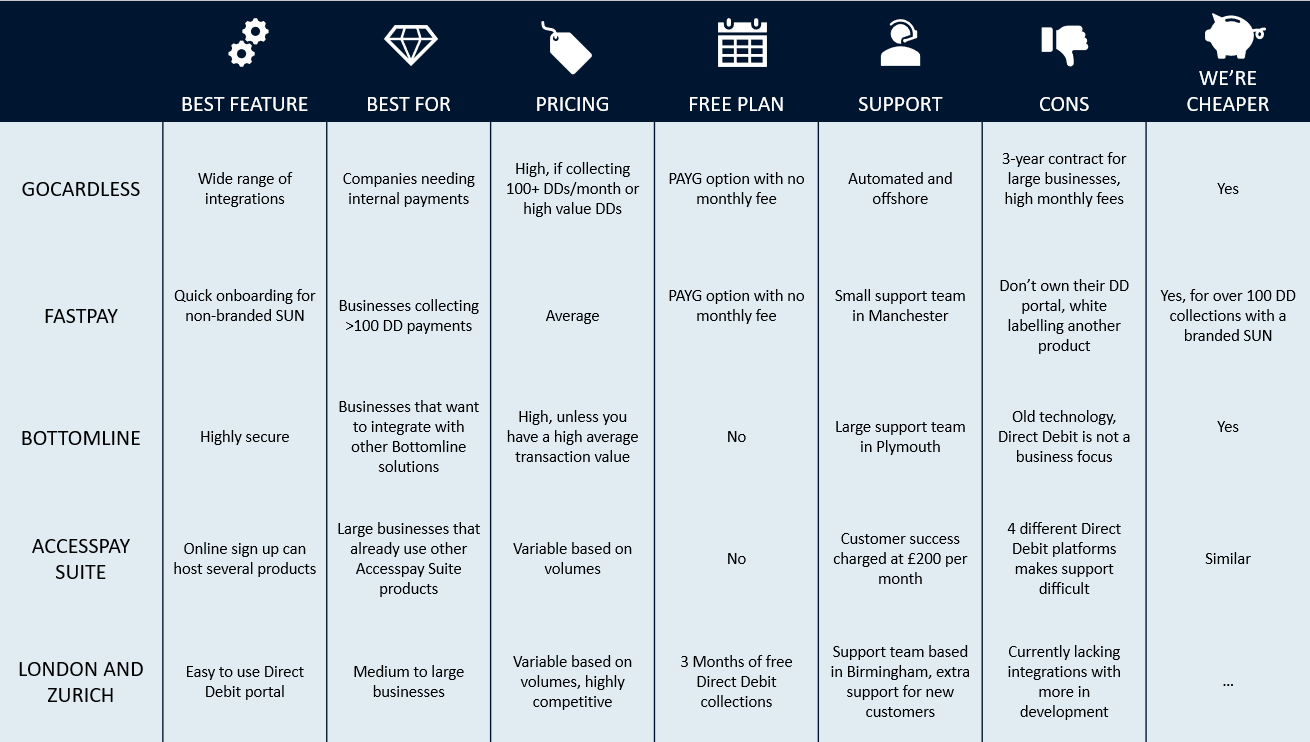
Read more: Direct Debit provider comparison guide
Want an honest conversation about whether London & Zurich is the right fit? Talk to our team.
How do I switch Direct Debit providers?
Switching Direct Debit providers involves migrating your existing mandates, notifying your customers and coordinating the transition between providers.
The fear of switching providers is often worse than the reality. We hear from businesses every week who have stayed with a provider they’re unhappy with because switching feels complicated or risky. In our experience, a well-managed migration is smoother than most people expect.
We do things properly and get to know your business. When does switching make sense?
- You’re not getting adequate support from your current provider
- You’re paying more than you should be
- You’ve moved to another bank and lost bank sponsorship for your SUN
- Your provider has been acquired and the service has changed
- Your provider’s software is awkward to use
- You’re outgrowing your current platform
- You need compliance support your current provider can’t deliver
- You want to work with people who actually answer the phone
How the switching process works
- Initial assessment: We gather the required Bacs and onboarding information that covers what Direct Debits you want to migrate to us, and some details about your incumbent provider.
- Migration planning: We define a transition timeline, including key milestones, dependencies and any recommended quiet periods to minimise disruption to your collections.
- Mandate migration: Existing mandates are transferred to the new Service User Number via a Bacs-approved bulk change process. In most cases, your customers don’t need to re-sign anything.
- Notify your customers: We support you in sending Bacs-compliant advance notice communications informing your customers of the change.
- Go live: Collections begin on the new platform, sometimes with a short parallel run before the previous provider is fully switched off, depending on reconciliation and any outstanding collections or refunds..
Will my customers need to re-sign their mandates?
Existing mandates can usually be migrated to a new provider without customers needing to take any action. For the Bulk Change, they don’t have to sign new DD Mandates – they just need to be made aware of the change.
Can I switch without losing any collections?
Yes, with a properly managed migration, you shouldn’t lose a single collection when you switch. The key is timing the transition carefully around your existing collection schedule and ensuring mandates are fully migrated before you switch over. Our team handles this as standard.
How long does switching take?
Every business is different and comes with its own challenges and complexities. That’s why we focus on getting things right, rather than rushing the process.
We advise allowing a minimum of 4 weeks for your migration. You’ll get an expected timeframe once we’ve fully assessed your unique set up. This way, you know exactly what to expect before the migration starts.
Thinking about switching? We’ll walk you through the process – no pressure, no commitment.
Key takeaways
- Switching is usually simpler than businesses expect
- Customers rarely need to re-sign mandates
- A well-managed migration takes 1-4 weeks
- Choose a provider with dedicated migration support – it makes a real difference
Read more: How to change Direct Debit provider
Direct Debit for different types of business
Direct Debit is used across almost every sector in the UK.
Whatever sector you’re in, Direct Debit works the same way at a technical level. But the way it’s applied – how mandates are collected, how amounts vary, how compliance is managed, how it integrates with sector-specific software – is different for every type of business.
Read our sector guides for more information about Direct Debits in your industry:
- Direct Debit for gyms and leisure businesses
- Direct Debit for IT and software companies
- Direct Debit for nurseries
- Direct Debit for accountants and professional services
Don’t see your sector? Talk to us – we work with businesses across every industry!
Direct Debit terms explained
Direct Debit has its own terminology that can feel confusing when you’re new to it. Here are the key terms you’ll come across, explained in plain English.
ADDACS: Automated Direct Debit Amendment and Cancellation Service. The Bacs process used to notify originators of changes to payer bank account details or cancellations.
AUDDIS: Automated Direct Debit Instruction Service. The electronic process used to submit new Direct Debit mandates to the Bacs system. Replaced the old paper-based process.
ARUDD: Automated Return of Unpaid Direct Debits. The Bacs message sent to an originator when a Direct Debit collection cannot be processed.
Bacs: Bacs Payment Schemes Limited. The organisation that runs the Direct Debit Scheme in the UK. Processes billions of payments each year through a three-day clearing cycle.
Bureau service: A managed Direct Debit service provided by a specialist organisation. The bureau holds the Service User Number and handles Bacs compliance and processing on behalf of client businesses.
Collection: A single Direct Debit payment processed through the Bacs scheme. A collection takes three business days to complete.
DDI (Direct Debit Instruction): The formal mandate given by a payer authorising a business to collect Direct Debits from their account. Also called a mandate.
DDICA: Direct Debit Indemnity Claim Advice. The Bacs message advising an originator that an indemnity claim has been raised against one of their collections.
Failed payment: A collection that cannot be processed. Common causes include insufficient funds, a closed account or a cancelled mandate.
Indemnity claim: A claim by a payer that a Direct Debit was collected incorrectly. Under the Direct Debit Guarantee, the payer’s bank must provide an immediate refund, which is then recovered from the originator.
Mandate: The authorisation given by a customer allowing a business to collect Direct Debits from their bank account. A valid mandate is required before any collection can be made.
Originator: A business or organisation that collects Direct Debits. Originators either hold their own Service User Number or use a bureau provider’s SUN.
Payer: The customer whose bank account is being debited. Also referred to as the Direct Debit payer.
Processing day: One of the three business days in the Bacs processing cycle. Day 1: submission. Day 2: processing. Day 3: settlement.
Reconciliation: The process of matching collected payments against expected collections and updating financial records accordingly.
Refund: The return of a collected payment to a payer, either following an indemnity claim or by agreement between the originator and payer.
Service User Number (SUN): A unique six-digit number assigned to businesses authorised to collect Direct Debits. Appears on payers’ bank statements as the collector identifier.
Settlement: The transfer of collected funds to the originator’s account. Occurs on day 3 of the Bacs processing cycle.
Submission: The process of sending Direct Debit instructions to Bacs for processing. Submissions must be made in advance of the collection date.
SUN sponsorship: The arrangement by which a bureau provider sponsors a business to use its Service User Number, enabling the business to collect Direct Debits without obtaining its own SUN.
Variable Direct Debit: A Direct Debit where the collection amount can vary from one payment to the next. The payer must be notified of the amount in advance of each collection.
Read more: Full Direct Debit glossary
Direct Debit FAQs
Can you set up a Direct Debit on a business account?
Any UK business with a registered bank account can collect Direct Debits, either by obtaining their own Service User Number (SUN) or by working with a bureau provider. Most small businesses do so through a bureau provider, which handles the Bacs compliance and processing on their behalf. You don’t need your own Service User Number to get started – your bureau provider uses theirs.
What is the best way to accept payments for a small business?
For recurring payments (memberships, subscriptions, regular invoices) Direct Debit is very often the best option. It has higher collection rates than card payments, lower transaction costs and significantly less admin. For one-off payments, card or bank transfer may be more appropriate.
What are the legal requirements for Direct Debit?
Businesses collecting Direct Debits must comply with the Bacs Direct Debit Scheme Rules, give customers adequate advance notice before each collection and handle customer data in line with GDPR and the UK Data Protection Act. Many bureau providers support you in meeting these requirements, but you remain responsible for compliance under the scheme.
Why do businesses use Direct Debit?
Because it makes recurring revenue predictable, reliable and low-maintenance. Direct Debit delivers higher collection rates than card payments, lower transaction costs, reduced admin and better customer retention. For businesses whose model depends on regular, repeat payments, it’s one of the most effective payment methods available.
What happens if a Direct Debit payment fails?
You’ll be notified via an ARUDD message from Bacs. Common causes include insufficient funds, a closed account or a cancelled mandate. Your bureau provider will help you understand the failure reason and advise on next steps – whether that’s re-presenting the collection, contacting the customer or updating the mandate.
Can a customer cancel a Direct Debit without telling me?
Customers can cancel a Direct Debit at any time by contacting their bank. Under the Direct Debit Guarantee, this is their right. You’ll be notified via an ADDACS message when a mandate is cancelled. It’s good practice to have a process for following up with customers who cancel unexpectedly.
Do I need a Service User Number to collect Direct Debits?
No, you don’t need your own SUN if you use a bureau provider. A bureau holds its own SUN and uses it on your behalf, handling all the Bacs compliance and processing. If you want your own SUN, you apply directly to your bank, though many smaller businesses find the bank route difficult and use a bureau provider instead.
Explore all of our Direct Debit FAQs.
Ready to set up Direct Debit for your business?
You’ve read the guide. Now talk to someone who’s been doing this for thirty years. Give us a call for an honest conversation about what’s right for your business.
Further reading and resources
Getting started
- Beginner’s guide to Direct Debit mandates
- Guide to Service User Numbers
- How to get started with Direct Debit
- How to set up Direct Debit for customer payments
- How to set up Direct Debit for your small business
- Understanding Direct Debit
- Taking payments by Direct Debit
Compliance and security
- Direct Debit scheme rules for businesses
- Understanding the Direct Debit Guarantee
- Understanding indemnity claims
- Enhancing payment security with Direct Debit
Costs and switching
- Direct Debit provider comparison
- How to switch Direct Debit providers
- How to change your Direct Debit provider
- How to move your customers to Direct Debit
Sector guides
- Direct Debit for gyms and leisure businesses
- Direct Debit for IT and software companies
- Direct Debit for nurseries
- Direct Debit for accountants and professional services
External authoritative sources
- Bacs Payment Schemes
- Financial Conduct Authority register
- UK Finance payment statistics
- ICO GDPR guidance
- Financial Ombudsman
- UK Finance